

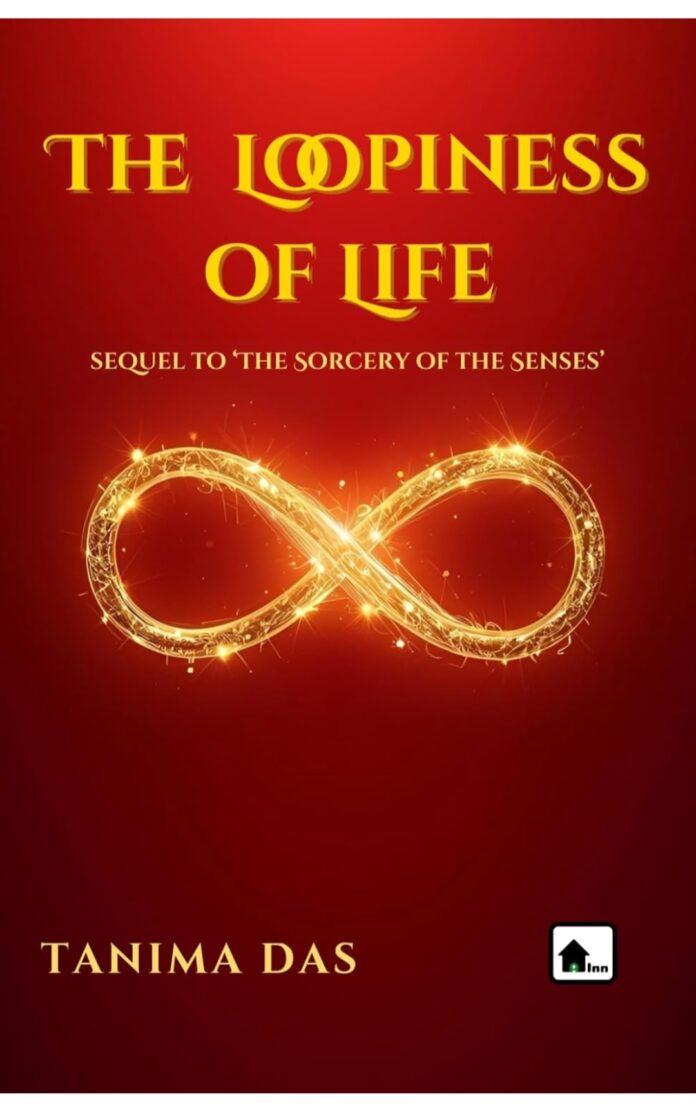

The Loopiness of Life by Tanima Das picks up seamlessly from where The Sorcery of the Senses left off, making it feel less like a standalone novel and more like a natural continuation of an already unfolding universe. Readers familiar with the first installment will appreciate how the author does not pause to over-explain but instead trusts her audience to dive straight back into the layered world of reincarnations, senses, and shifting realities.
At the heart of the story remains Dhruv, the central protagonist, who undergoes noticeable evolution in this second part. Yet, what makes him compelling is not a complete transformation into a heroic ideal, but the fact that he remains deeply human. He is flawed, conflicted, and often uncertain. His growth feels organic rather than forced, shaped by experiences that challenge his understanding of self, morality, and destiny. Dhruv’s imperfections make his journey relatable, anchoring the fantastical elements in emotional realism.
In contrast, his wife Juthika emerges as a far stronger presence in The Loopiness of Life. She is no longer just a supporting character but a force in her own right. Her resilience, clarity, and emotional strength add depth to the narrative and subtly shift the balance of the story. Juthika’s arc stands out as one of the most satisfying aspects of the book, offering a refreshing portrayal of inner strength without slipping into cliché.
One of the novel’s most intriguing aspects is its continued exploration of reincarnation and the senses. These themes are not merely decorative but central to the narrative’s structure and philosophy. The idea that lives loop, overlap, and echo through different sensory experiences gives the story a distinctive texture. Adding to this richness is the inclusion of an LGBTQ+ character, whose journey quietly exposes the unfairness and rigidity of societal norms. This representation feels thoughtful and relevant, woven into the story rather than inserted as a token gesture.
Tanima Das’s imaginative power is evident in the construction of multiple worlds within the novel. Each realm feels distinct, with its own emotional and conceptual logic. While the narrative often leans more towards “telling” than “showing,” this stylistic choice does not detract from the reading experience. On the contrary, the clarity of narration helps maintain momentum and ensures that the complexity of ideas never becomes overwhelming.
The final stretch of the book is particularly action-packed, with a climax that brings together multiple threads in quick succession. A great deal happens in the last few pages, lending urgency and excitement to the conclusion while reinforcing the cyclical nature of the story.
A special note of appreciation must be given to Room 9 Publication for supporting and bringing to print such an imaginative, inclusive, and genre-driven work, contributing meaningfully to contemporary Indian fantasy literature.
Overall, The Loopiness of Life is an enjoyable and imaginative read, firmly establishing itself as a worthy participant in the fantasy genre. With its inventive worlds, evolving characters, and thematic ambition, the book leaves readers intrigued, satisfied, and curious about what lies ahead in this looping journey of lives and senses.
****
The book is available Amazon
The review of Part 1 The sorcery of the senses