

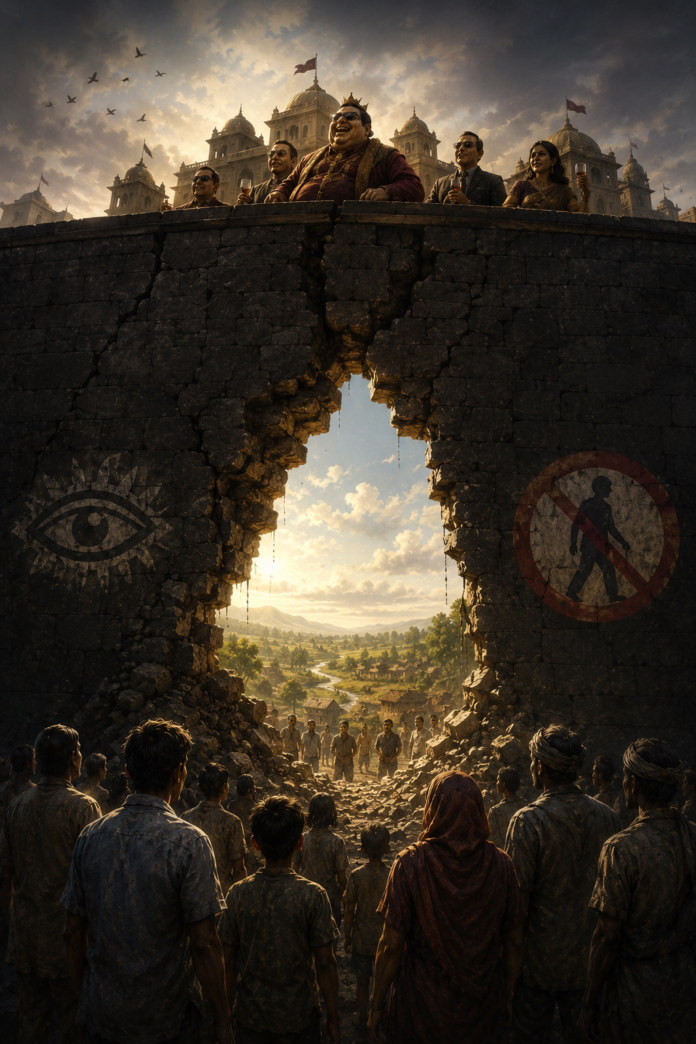

Crumbling houses, endless taxes, and the magnificent Wall of Eternal Safety identified the village of Dharmapur. The giant black wall surrounding the village on all sides stretched up so high that even birds seemed afraid to fly above it.
And a single sacred rule governed the villagers:
Never cross the wall.
The rule appeared everywhere. It was painted on houses, carved into school desks, stitched onto flags, and even printed on the ration cards.
Children learned it before they learned the alphabet.
“Why?” they would ask.
“Because monsters live outside,” the adults would warn.
Not ordinary monsters, of course. According to the Ministry of Safety, these creatures resembled humans but despised morality, civilization, and Dharmapur’s traditional values. Apparently, values mattered more than drainage or clean water.
Every year, the Supreme Protector climbed the balcony overlooking the square and addressed the villagers.
Spreading his arms toward the crowd, he would declare, “My beloved friends, beyond this wall live savage monsters waiting to destroy our way of life!”
The villagers gasped every single year, although nobody had actually seen these monsters. They had heard stories. Once, news spread that monsters had snatched a child. The parents committed suicide out of grief. Sadly, nobody knew them personally, but that didn’t make the story any less horrific.
The Protector bellowed,
“Without us guarding the gates, the monsters would invade, destroy your homes, and eat your children!
Remember the sacred rule: Never cross the wall.”
Thunderous applause followed as the villagers forgot about their leaking roofs, empty grain sacks, and arguing over potatoes.
Mostly because attendance was mandatory. Besides, whenever someone questioned authority, unfortunate things happened
A schoolteacher once asked, “If the monsters are so terrible, why do the leaders’ children somehow return from these dangerous journeys healthier, wealthier, and educated abroad?”
The next morning officials announced that the monsters had eaten him.
“The loss of a patriotic soul,” the newspapers reported.
A farmer once wondered aloud how the leaders’ marble palace was growing taller each year while their huts were crumbling down.
Officials claimed the monsters ate him too.
A poet wrote a satirical play titled Maybe the Wall Is the Problem.
Nobody ever saw him again.
Naturally, the people became docile.
Meanwhile, the leaders lived a lavish lifestyle near the Sacred Gate, the only opening in the wall. But that was understandable. They risked their lives for the safety of the masses.
“Our sacrifice keeps you alive,” they constantly reminded everyone from marble balconies.
The villagers believed them despite the awkward fact that the leaders returned from the deadly diplomatic meetings with more silk and imported wine. But in Dharmapur questioning authority counted as crossing the wall mentally.
The Ministry of Truth worked tirelessly to maintain national unity.
“MONSTERS HATE YOUR FREEDOM!”
“DOUBT HELPS THE ENEMY!”
“HUNGER IS TEMPORARY — SECURITY IS FOREVER!”
And all was well.
Then came the earthquake.
It struck one day at noon with terrifying force. Houses crumbled, towers fell and with a deafening crack, the Wall itself fractured down the center.
The villagers froze.
Through the dust appeared shadowy figures from the other side.
The villagers screamed. The strangers screamed louder.
Both groups stared at one another in horror.
One frightened man whispered, “They look human.”
A woman beside him hissed, “That’s exactly how monsters trick you.”
Nobody moved until a small child climbed over the rubble and asked,
“If they’re monsters… why do they look poorer than us?”
Then an old woman from the other side slowly stepped forward.
“Wait,” she asked, “your leaders also told you never to cross the wall?”
The villagers blinked.
Over the next few hours, generations of propaganda collapsed faster than the earthquake debris.
The other village had the exact same rule.
Never cross the wall.
They had the same fear. The same speeches. The same disappearing critics. The same starving citizens defending leaders who traveled in opulence through the sacred gate “for the people.”
One man from the opposite side sighed. “Our leaders said you monsters wanted to destroy our freedom.”
A villager from Dharmapur looked around at the collapsing houses and empty grain stores.
“What freedom?”
Soon they discovered hidden tunnels beneath the wall. Crates of grain sat untouched beside shelves of medicine coated in dust while both villages starved and buried fever-stricken children. Long banquet tables stretched across the chambers, littered with imported wine bottles and signed photographs of leaders from both sides toasting together.
In a locked drawer lay lists of missing villagers. Beside each name, stamped neatly in red ink, were the words:
“Monster incident resolved.”
The villagers stood speechless. The monsters had existed all along. They simply held office.
By sunset, the leaders had already fled together through private escape tunnels carrying gold, food reserves, and sacred emergency funds.
For the first time in history, the people from both sides sat together without walls between them, sharing their food, stories and a common humiliation.
And beneath the ruins of the fallen wall, the two villages finally understood the oldest political trick in the world:
If you convince ordinary people that their neighbours are monsters, they will never notice the real predators standing at the podium.
-x-
Note:
Prompt:Inntales-5
This is a work of fiction. Any resemblance to actual persons, living or dead, events, institutions, or places is purely coincidental. The author is an admirer of Orwellian literature, and this work draws significant inspiration from the dystopian themes and narrative spirit associated with George Orwell.
What an amazing read, so well written ! Loved it!!
Thank you so much